Tuesday, June 21, 2016
Coming to Copenhagen
Before we start our sailing each summer, we like to fly into a part of Europe that we haven’t seen and somewhere we are unlikely to bring the boat. For 2016, we decided to fly into Copenhagen. What a beautiful city. It reminded me of Amsterdam. There are canals running throughout the city. First built as a defense for the city, they later became an important key in making Copenhagen a center of commerce. The name of the city comes from the Danish word , Køpmannæhafn. Hafn means harbor. Copenhagen literally means merchant’s harbor.
One of the first things we did was jump on a canal boat to get an overall feel for the city. Low bridges, three story homes stacked together like colorful books on a crowded library shelf line both sides of the canals. The public buildings are fanciful and often crowned with spires that look like they came from some enchanted kingdom. It is as if someone strung interesting shapes and skewed them all together across building tops scattered throughout the city. This is the land of Hans Christian Andersen and the city has a feel of a child’s fairy tale. You gotta love a city where the main parliament building tower looks like it is made out of solid chocolate. Or a church that has a winding staircase wrapped around it’s steeple allowing worshipers to literally climb the stairs to heaven and view the city below. Or a government building that has three dragons tails weaving to gather to form the spire.
And of course, this enchanted city needs a mythical amusement park right in the center of town. Tivoli Gardens built in 1843, a full century before Disneyland was even conceived. It is the perfect fun filled centerpiece for this city. While it has been updated and changed over the past century, the park still manages to retain an old world charm about it’s rides. The locals tell us that everyone has an annual pass and spend many a long summer night hanging out there. They call it the cities backyard.
And every far far away land would not be complete without a population that was equally enchanting. The Danes are so kind and so helpful. It is completely understandable why Denmark is ranked as one of the most livable countries in the world. Now if they could just warm the place up a little. It was freezing there all week. The Danes say there are no cold cities, just bad choices in clothing.
Killing Time at Kalkara
When we anchored in the Grand Harbor, we were right next to the small community of Kalkara. It is not more than a big church, and a few assorted mom and pop stores. We grew to love the community and they took us in as well. We befriended an older guy one afternoon at the local cafe. He told us that no matter what, we had to be here for their town festival. Each town no matter how small has a two day festival honoring and celebrating the town patron saint. And celebrate they do. They spend weeks hanging garland, lights and banners throughout the town. Then life size sculptures made from wood and painted in faux marble are places along the main street. Overwhelming firework displays the likes of which, I have never ever seen before, are prepared for the celebration. A feast is prepared and on the night of the rivalry, not one, but two bands march through the town, calling all the people like modern day Pied Pippers as the town folks fall behind as the bands winds through the village,leading them to the central square. Music is playing, dancing in the street, consession stands filled with carnival food, fireworks going off and town revelry continue into the wee hours of the morning. Our friend from the cafe finds us and takes us under his wing to explain what all this means and to share in its display of majesty. He is rightfully proud of the display of devotion to their patron saint. It was a night I will never forget. And this happens in virtually every town, large and small throughout the summer. Malta has 10 firework companies supplying the population for their thirst for bombardment displays. There were very few evenings during the entire summer that we didn’t see fireworks both near and far dotting the darkened sky.
Plunging into St Peter’s Pool
Another favorite anchorage was near St Peters Pool on the south part of Malta. Large slabs of smooth rock make an ideal place for the young and beautiful to spend the afternoon. All are dared to jump off the 15 foot cliff into the cobalt blue sea below. But none do it better than Peppi and his loyal dog. An older guy with a deep tan potbellied body, and heavy gold chain around his neck. He doesn’t hesitate to casually walk to the rim to dive with grace off the high cliff into the pool. But equally fearless is his pint size terrier who in sync with his owner also plunges to the depths below. If they ever have an Olympic event of synchronized dog/man diving, Peppi and his dog have a running chance to accumulate more gold for around his neck.
Months on Malta
We spent the summer of 2015 idiocy dropping anchor in one beautiful bay after another. The three islands of Malta are so small we could easily sail around the whole country in a single day. So for most of the summer we would only unfurl our jib to take us to the next secluded bay or we would arrive too quickly.
We definitely had our favorite anchorages. Certainly the Grand Harbor is one of the most amazing natural harbors anywhere in the world. And slicing through the center of this Grand Harbor is the peninsula that makes up the capital city of Valetta. The summer there is full of culture, art, performances and festivals. And the church of St John is not to be missed. From the outside it looks like a simple fortress-like church with little adornment. But step through the vestibule and you are transformed into an international display of grander and wealth. Each of the niches that surround the main alter was gilded to the maximum by the 7 countries that made up the Knights of St John. The niches became a source of national pride as each country tried to outdo the other in showing off wealth and artistic devotion to Christ.
Magnificent Malta by Knight
We spent the summer of 2015 sailing the small island country of Malta. Strategically placed between Africa and Europe, these three islands of barren limestone has been a country the world powers have wanted to control for centuries. While there is evidence that Malta has been inhabited for over 5,000 years, it’s modern history includes occupation by the Greeks, Phoenicians, Romans, Spanish, French, English and many others throughout the centuries. Generally, whoever controlled Sicily, also controlled Malta.
Perhaps the history that Malta is most known for is when the Knights of St. John took possession of these small islands. After the fall of Jerusalem during the crusades, the knights went to Rhodes and set up a fortress. But in 1522, a 6 month siege by Suleiman the Magnificent and his force of 100,000 (some sources say as many as 200,000) men captured the knights. The knights were allowed to leave Rhodes, on the condition that they never attack the Ottomans again. Without a home, they wandered for a couple of years until Charles 1 of Spain offered them the Island of Malta in exchange for a falcon to be paid each year as rent. Just as in Rhodes, the Knights of St John built great fortresses to protect themselves from invading forces. And as soon as they had their fortress in place they once again started plundering Suleiman’s trade ships. The result of the knights breaking their promise culminated in one of the most incredible stories of a military beating unbeatable odds. Suleiman and his 40,000 troops attacked this fortress against 700 knights and 8,000 soldiers. What looked like an easy victory for the Turks ended up being an agonizing defeat. After months of fighting, only 600 men on Malta were left that could bear arms. But seeing no hope of victory, Suleiman sailed back to Turkey with only 15.000 troops. The rest of his once confident army were all dead, lying at the bottom of the walled city fortress.
Reminders of Malta’s past warring siege surrounds us. Sitting on my boat in the Grand Harbor, I can easily see Fort Elmo that held off for months with just a couple hundred men. As I look to the east, I see St Michaels church surrounded by the strong fortified walls that served as a refuge and final holding position that in the end defeated the greatest army of it’s day. At noon every day, they still fire off cannons to commemorate their great victory over the Turks.
It Takes a Village
We are back in Sicily after a wonderful winter in San Francisco. There is much work to be done before we can start sailing. It seems less dirty than usual. We are told that there was a lot of rain this winter. Perhaps that rain was enough to keep the Sirocco winds carrying red Sahara sand from staining the boat as much as usual. There is still plenty to do: raising the sail, inflating the tender, servicing the engines, and mostly scouring the boat from top to bottom. And by bottom, I mean scraping both hulls free of the season’s crop of barnacles and assorted sea life. I do a rough scraping here at the marina. It will take a couple of weeks when we are anchored out to get the keel completely clean.
Among our many projects, I wanted to put a new layer of rubber on the front of the tender where it had rubbed over the years. So I get a list together of what I needed.
There is a little hardware store here in Marina di Ragusa that I get these kinds of supplies. An elderly couple run the place. Neither one speaks a word of English. But there is usually a young woman who is able to figure out what I want. Well this year she was nowhere to be found. So I talk to the wife of the owner. With the help of the rest of the customers and through the talents of pantomime, they figure out that I am looking for some kind of glue. What I was looking for was contact cement. I even knew the Italian for it, contacto cemento. Yeah I am not making that up. But the elderly couple only speak Sicilian. Even Italian is not working. And I am beginning to doubt that I am even asking for the right thing in Italian. I had no idea how many kinds of glues they can have in a hardware store. They brought out maybe 15 different glues, none of which were contact cement.
At that point, I pretty much gave up and continued down my shopping list. Just when I was about to pay for everything, one of the customers who had been doing most of the translation presents me with a can of contacto cemento. Yeah I had it right. I have them open up the can just to be sure. And thank everyone profusely for all of their help. Each one of the people there played a dramatic role in this endeavor. The guy that was doing most of the translating good-naturedly says I owe him 10%. Well somehow the elderly woman completely understood what he was saying. She looks at me and draws her baby finger from her eye down her cheek. You don’t have to be in Sicily too long to understand the signal. She is in good humor, giving me the sign that her customer is in the mafia.
I gather all my items and pay for them. But before I can leave, the woman goes behind the counter and gives me a big bag of fresh tomatoes from her garden. You gotta love Sicily. The people here are what I love most about the island. They are always so kind, patient and willing to help. It feels like we are home again.
Night Crossing
We needed to make the crossing from Sardinia to Sicily. It is about 150 nautical miles, which we calculated would take about 24 hours if we motored at full speed. We timed our departure from Sardinia at 9 a.m. so that we would arrive in Sicily during the daylight hours the next day. The winds were strong, about 20 knots and the waves were big, about 6’. If the wind and waves were coming directly at us, we would have had to wait for calmer weather. But because the winds were at our back, the sailing was fantastic. And the waves end up pushing the boat forward. When the waves are that big and coming from behind, the boat actually surfs the waves and accelerates the boat as it slides down the wave. Queue Beach Boys music, and it makes for a great time. We averaged close to 9 knots under sail and even got up to 14 knots at one point, which is actually twice as fast as the engine speed. The sailing was so good that when we finally did put on the motor as night fell, we had to slow down the engine speed so that we wouldn’t arrive in Sicily before daylight.
Just when we were leaving Sardinia, we saw a flamingo in flight cutting close to the sea. Their long necks and dangly feet stretch out like a baseball player sliding into home plate. For some reason there are big flocks of flamingos in Sardinia. We had seen them before. This was to be the beginning of a very magical 24 hours.
As if to escort our boat on its passage, a pod of dolphins came over to play. They played right between the pontoons, swimming and jumping in unison like a well-rehearsed act at Marineworld. I think we have seen more dolphins this summer than ever before. Each time it is a memorable experience. These gentle mammals love interacting with humans. I always feel a spiritual connection to them.
I have heard of whales in the Mediterranean, but in the 8 years of sailing the Mediterranean, it seemed more like a mythical promise right up there with unicorns. I don’t even think I have met someone who has actually seen a whale. But it happened. It was in the early afternoon. Right off our portside bow, about 100 feet from the boat, we saw a waterspout. Then another one and we could make out the back of the whale just breaking the surface. It was so close, as thrilled as I was, I have to admit that I had thoughts of this whale coming up underneath the boat and having a very bad ending to our crossing. Then the whale rose up, exposing his huge gray body, turned slightly on his side and plunged back into the sea with his massive tail slapping the water as if it was waiving a final good bye. We hoped that we would get one more good look at it, as I ran down to get my camera, but that was the end of the show. Wow. One of the most amazing things I have ever seen while sailing.
This wasn’t to be the last of our amazing encounters while making the crossing. We knew that we would have to take turns during the night keeping watch. So I decided to lie down for a little nap. While I was sleeping, Steve spotted a huge sea turtle. We have seen them before over here, but he was surprised to see one so far out to sea. They are huge, about 3 feet across.
While we were half way across, a hawk circled the boat and landed on top of the mast. This bird was exhausted, and we were the only option he had. The natural shifting of the boat in the wind made it difficult for this poor hawk to find a comfortable place to rest. He would try a spot for a few minutes, on top of the jib, on top of the radar, on the jib line, even in the jay sling, but each time it would knock him around just a little too much and he would circle around looking for a more stable position. It seemed like the most stable places were also the ones closes to us. He finally settled on the cross brace supporting the radar, took a break and then was off hoping to complete the rest of his journey. At this point we were probably 12 hours from any land in all directions. Hope he made it.
An exciting day as darkness spread across the sky. One by one, the pinpoint stars pricked the black skies until we could see more stars than can be imagined. The sliver of the moon set early, at about 11pm, which made the night sky even darker. The Milky Way extended from horizon to horizon and truly was milky as billions of stars appeared.
What we also saw is luminescent sparkles lighting up a trail of water behind the boat. We have seen this before in the Med. Plankton that when disturbed light up briefly creating a look of fairy dust as the water is swished around. I think one of the most enchanting things I have ever done here in the Med is swim at night when these plankton are present. Each stroke of the hand lights up a trail of glitter. Each kick of the feet sends a trail of sparkle. While it is a bit creepy swimming at night with no light, you are soon overwhelmed by the beauty of this natural light show.
Then an even more mystical phenomenon. Big glowing balls started to appear at the back of the boat as well. They would pop out in groups and sometimes individually. It was like a nerf gun was blasting these spheres of light. Some were small, about 4 inches across, and some were rather large, about 10 inches across. Turns out, they were jellyfish that also are luminescent when disturbed by turbulence. The combination of the fairy dust plankton and round balls of glowing jellyfish really was something so unexpected and something that you could only have seen at night time. I tried to photograph them, but only got a black screen.
Ok if that wasn’t magical enough, later in the night we saw long streaks of light coming up next to the boat. It was two more dolphins swimming next to us. Because of the luminescent plankton they were completely lit up like they were encrusted with twinkling diamonds. A trail of light made by their tails slapping in the water followed them. How much better could this night crossing have been.
As morning broke, we saw first a glow fading the night sky that evolved into a spectacular sunrise. In the distance, we could see the islands that are right off the coast of Sicily near Trapani. A thin haze hid the mainland for an hour until it too dissolved and the shores of our destination appeared. This crossing ended up being one of the highlights of summer. I will never forget it.
Ajaccio and Napoleon
We are anchored out in a large bay that surrounds the capitol city of Corsica. It is a big modern city with not much remaining of it’s historical history. Most of that history centers around this being the birthplace of Napoleon Bonaparte. It is a history that the town people are clearly proud of, though it is not always been so.
Napoleon’s parents came here when his mother was very pregnant with her famous son. His father came to work in government, partly to ensure that his children would gain a solid education. And as was the custom, young Napoleon was shipped off to military school in Paris at the tender young age of nine. Yeah nine. By the time Napoleon was 16 he was appointed a lieutenant. When the French revoluton began, Napoleon’s father choose the wrong side, and when the revolutionaries won, their home was ransacked and the family was hounded from their home their fortune and good name destroyed. Napoleon brought them to Toulon for safety. Napoleon gained power and influence and from that time on, marched across Europe and into the history books.
He only visited Corsica one more time during a journey from Egypt. Though Napoleon commissioned numerous statues of himself in countless places, he never commissioned one in his home town. While there are numerous statues of him scattered throughout the city, they were all put there after his death and after his history was firmly decided upon. A sort of god-like cult developed after his death. People would make prilgrimages to his home and take what they could. They even peeled of scraps of wallpaper to sav as a remberance of this god-king until nothing was left of his childhood home. Of course, that has all been restored and furnished to become a museum to honor this favored hometown hero.
Coast of Corsica
We raised our sails and started down the rugged coast of Corsica. This French island has all the charm and amazing landscape. Like the American and French flag, the blue of the ocean is deep and rich. The beaches are white sand. And the tourists that flock to the many resorts are red with sunburns. And like the flag that looks it’s best waving in the summer breeze, this island gets a lot of strong winds. It seems like the wind is either at full force, often so strong we have to seek shelter in the many coves or there is no wind at all. Now if they could just even things out a bit, this would be paradise to sail in.
Tuesday, May 27, 2014
Hoist up the Sails
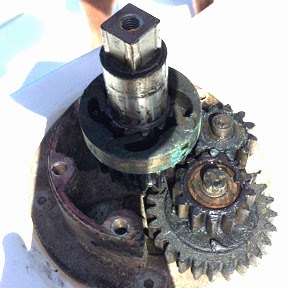
We arrived back to Marina di Ragusa where our boat resided for the winter. We spent a couple of weeks of cleaning, waxing, polishing, buying supplies, fixing minor repairs, more waxing and polishing, blowing up the tender and all the other myriad of things required to get the boat ready for the summer. The pictures are of one of the winches. We have to strip every gear apart and relube them every couple of years.
We set sail on May 15 to officially begin the summer season. It is so amazing to be back on the boat. It feels like home the minute we hoist the sails and punch in our destination for the day into the navigation system.
We hop along the southern coast and then turn northwest up through the Straits of Messina. The towns along the shores are ones we are familiar with and have spent the last summer exploring. Porto Paulo, Syracuse, Catania, Taromina and Messina all bring back memories of past trips. Finally at Messina, we say our goodbyes to Sicily and head to the Italian mainland.
Sicily may be a part of Italy, but it is not Italy. The culture and people are remarkable different. Our first stop on the mainland is Tropea, one of my favorite towns in the south. Built on a flat plateau that plunges hundreds of feet into the sea below, this town has charm and character that has aged well through the centuries. The shops and stores rise straight up from the sheer cliffs, bleeding directly into the cliffs to the point that it becomes difficult to distinguish where the cliff ends and the town begins. It is like a water color painting that the color of the houses on top have run down into the cliffs below. After climbing 200 steps to get to the top of the bluff, you are rewarded with stone-block streets, small shops, wonderful food and yes, beautiful Italians.
Italians seem to have this Jackal/Hyde nature about them. I have pulled into ports and the local fishermen have jumped up and down telling me I have no right to dock my boat in there harbor and they will call the authorities if I even think about staying there for the night. But when asked where I should go, they will smile and say “Oh just stay where you are, no one will care.” You see men on the street passionately arguing with each other nose to nose with only inches separating them and then a moment later, the argument is forgotten and full embracing hugs are wrapped around each other. They glory in the noble history of the ruins of a once great civilization, but have no problem defacing those same historical treasures with adolescent graffiti. The men are flashy and pay fastidious attention to their clothes, with just the right shoes, just the fitted shirt and the perfect pants, yet leave their cars unwashed and trashed for weeks. The women are also dressed to the nines even when they have no particular place to go. Short skirts worthy of a prom flashing shapely legs, 6 inch stilettos and lots of glam are typical outfits to go get pizza in the early evening. They can’t go anywhere without sparkling. The children are spoiled rotten, challenging their parents with foot stomping statements and defiant looks and the next minute wrapping arms around whoever is walking next to them. I love Italy with all it’s Janus-like contradictions. It is good to be back on the mainland.
Turning Heads in Turin
Today is Palm Sunday, and while Italians don’t carry around palm fawns, they do carry around olive branches. I think it is just an indigenous way of acknowledging the same event Italian style. We decide to take a train to Turin from Bologna. But on this particular day, the trains are on some kind of strike. The first train we planned to take left the station without letting any passengers on board. So we cross our fingers, and cross platforms in hopes the next one decides to take passengers. The train is there at the platform, but no one knows if the engineer is going to actually take on passengers. The closer to the departure time, more religious the people on the platform become. Some blessing the train tracks with their olive branches, some content with the traditional signing of the cross, and some going with the never fails, I hope, crossing of the fingers. While waiting, we form a little bond with our fellow travelers. An Italian who is clearly used to this kind of behavior says, “It’s Italy” which for her explains everything. Ten minutes after it was suppose to debark, the doors swish open and the platform people swarm aboard before the engineer changes his mind. But the blessing does not cease until the creak of the wheels are heard. Then in unison, everyone breathes once again.
As grand as I thought Bologna was, Turin manages to trump. This is a city with grand palazzos, one right after the other. For me, the most impressive building and one of the most interesting I have ever seen is the Mole Antonelliana, an amazing structure built in the 1800’s. Originally it was commissioned by the Jewish community to be a grand synagogues. But somewhere along the way, the architect and cost got so out of hand that the Jewish community withdrew from the project. The citizens of the city were so enthralled with the building that the city took over the project and completed it after the death of the architect to its now grandeur. They weren’t quite sure what to do with this building, however, but after a few tries at different uses, it settled in to becoming a magnificent museum of the cinema. And it is magnificent. As big as any Cecil B. DeMill extravaganza. We spent hours in there, and still felt like we were rushed.
One of the things I really wanted to see was the Shroud of Turin. Perhaps the most well known medieval relic, it was purported to be the actually burial shroud of Jesus. It first appeared in the 1400’s. People have been trying to figure out it’s authensity every since. In 1988, however the myth was exploded when carbon dating came back proving that it was no older than the 12th century. Of course, those that have it dispute those findings and still cling on to it’s authenticity. Seeing it proved to be as illusive as determining its legitimacy. We went by the museum 3 times and always it was closed. I knew that the original is rarely put on display, so in the end, we never got to see it or the copy that is on display. I know, kind of sad.
A Slice of Bologna
A couple of years ago, I read a novel that took place in Bologna. Every since then, I have been interested in the tall medieval towers built in the 13th century. It seems like the wealthy families at the time wanted to show off their wealth in a very visible way. The towers stood as a symbol of a family’s power and influence, the higher the tower the more influential a family was. They also served as safe havens and lookout spots for a nervous aristocracy. Perhaps the best known tower in Bologna is Torre degli Asinelli, which stretches 97.20 meters into the sky and leans by two meters. Between the 12th and the 13th century, the number of towers in the city was very high, possibly up to 180. During their heyday, there were high aerial bridges connecting important families together so that they never had to actually go down to the streets below where all the “little people” lived. How strange it must have been to see this far off city in the 13th century that looked more like modern Manhattan than a medieval town. While we were there, we visited a museum. There was a painting with a small detail of what Bolonga looked like at the time. You can see from the painting that some of the towers were already starting to lean. Of the numerous towers originally present, fewer than twenty can still be seen today.
The other amazing architectural feature of Bologna is the amazing number of porticoes walkways connecting the city together. There are over 38 kilometers of these covered walkways. You can virtually walk to any part of this amazing city under these grand covered walkways. It’s a great city to visit even during a rainy day. It all seems so civilized.
I am not much into collecting souvenirs when I travel. It seems more like you are collecting dust rather than memories. And the boat has only so much shelf space. But one of my favorite things to collect is taking local cooking classes. So Steve and I signed up for a morning cooking class. When we arrived, we were the only ones whose native language was English. The class started in Italian. That was going to be a problem. So the instructor switched to basic English. You know the type that occasionally his word choices were a bit hilarious. It turns out everyone spoke some English. And when we didn’t quite understand what was being said, someone was more than happy to help us out.
We ended up learning how to do a 7 course Italian meal starting with appetizers that were amazing, made our own pasta and sauce, and finished with dessert. It was both amazingly helpful and delicious. We got to eat all of our creations at the end of the class. It is going to be a bit difficult to make any of the dishes on the boat because of so many special ingredients and the space to spread out. Rolling out pasta along takes up more than the counter space I have on the boat. But I can’t wait to get home and try mastering each and every savory dish. Yummm.
While we were there a special exhibit of Dutch masters was going on. The superstar of the collection is Vermeer’s “The Girl with the Pearl Earring”. And it is a masterpiece. It originally sold at auction in 1881, almost 200 years after Vermeer’s death for 2 Guilders 30 cents. That is less than a dollar. How did a painting that was once considered almost worthless rise to become one of the world’s most treasured works of art?
Bards and Balconies.
After a winter in San Francisco, we once again find ourselves back on our adventure. We flew back to Milan, but instead of spending more time in the city, we took a train to Verona just a little over an hour southeast of Milan. The city of Verona is, of course, home of the legendary Romeo and Juliet. And though this famous work by Shakespeare may be factious, the opportunity to catch romantic tourists is not. So of course Verona has the famous balcony of Juliet as well as her sarcophagus, though they are not located in the same building claiming to be the family home of the Capula. If someone could explain that to me, I would love to understand. But then again, how do you have an authentic sarcophagus of a fictional character.
It is rumored that the legend did have its origins in fact, but Romeo was really Pietro, a handsome clerk from Florence. Juliet was born in Venice, the daughter of wealthy Bartolomeo Cappello. They fell in love and Pietro whisked her off to Florence when they were only 15. However, she did not get on well with her husband's family, who were very poor. They both died on the same day, possibly poisoned, or as some historians believe, from malarial fever.
While Shakespeare may not have gotten it all historically right in the story, he did write one of the most beloved plays in history, which is all it really takes to make Verona residents happy that they have something to draw the gold coins from those making pilgrimages of love to their fair city.
Verona itself is a beautiful walled renaissance city that still retains much of it’s glorious past. It is built along the banks of a fast moving river that almost completely loops around it. At one time, the homes and shops had beautiful frescos painted that covered the outside walls. Now only a few fragments remain. In the central plaza however there is a beautiful example that still remains. This must have been a very prosperous city at a time when artistry was valued and enriched the citizens every day life.
Monday, August 5, 2013
Peeling Back Palermo
The
first time I visited Palermo, I was a bit disappointed in its dilapidated
state. Fountains that were once
stately were falling apart.
Government buildings built at a time of prosperity were crumbling. And much of the housing had seen better
days 300 years ago. This city
seemed to be falling down around their ears. I was not impressed.
We
are back in Palermo and decided to take another stab at the place. So last night we went out to absorb the
vibe of the city. Yeah the place
is still falling apart, but there is energy amongst the neighborhoods. There are hidden plazas that were once
grand but now look more like a set from an apocalyptic movie. In the middle of the rubble there are
street venders selling dinner off of carts, music is pulsing through the crowd,
smiles come easy and comradery are strung together all to create an atmosphere
of energy and community. We stop
at a sidewalk grill for a delicious kabob sandwich. Sometimes food off the street is the best. I watch as the cook carefully takes
pride in what he is about to serve us.
There is no hurrying him as he layers our panini with lettuce, grilled
chicken, tomatoes and special yogurt sauce. You can give the guy a 50-euro note and some one will melt
into the crowd, but eventually comes back with your change. There is a feeling of pride and trust
that is also a part of the streets.
People
seem to ooze out of the abandoned apartment buildings and come together despite
what is happening to the physical world, readily share of themselves with
perfect strangers. Easy smiles,
lots of side cheek kisses and frequent embraces are also a part of Palermo
after dark. The best part of
travel is the people you meet and the best part of any city are the
inhabitants. I love it.
Amazing Agrigento
We
anchored out off the small town of San Leone for a couple of days. While we were there, we caught the
local bus to the ancient ruins of Agrigento that are built up the hill on a
bluff that has a commanding view of the sea below. At one time, this was the fourth largest city in the known
world. It started out around 581
BC as a Greek settlement that quickly grew to a population of over 200,000
people. The Greek temples survived
as the population was conquered by a stream of armies that wanted the wealth of
the city for their own.
Certainly
the crown jewel of Agrigento is the ochre colored temple of Hera. This is one of the extremely rare
temples that has somehow survived the test of time to remain relatively in
tact. There are several reasons
why this temple has survived when so many others have not. The principle reason lies below the
surface of the earth. Evidently
this temple is built on hard rock that is floating on a layer of soft clay that
acts as a shock absorber, cushioning it from destructive earthquakes. Whether Greek engineers understood this
or not is still up to debate. Most
modern scientists however think that there is a strong likelihood that they
did. It is a beautiful temple with
tall stone columns surrounding it. There are a few other temples scattered
around, but none are as complete or as impressive.
What
has been added to the site is a beautiful sculpture of a fallen angel done in
2011 by Polish sculpture Igor Mitoraj. It is a giant cast
bronze work that is reminiscent of the kind of work done by the Greeks. This magnificent angle has broken off
limbs like so many other sculptures of antiquity and lies on it’s side as if it
has fallen from a grand pedestal.
The sculpture has grandeur and heroic proportions that even the Greeks
would have appreciated.
Sunday, June 16, 2013
Colorful Catania
This morning we left Catania, the second biggest city in Sicily. I remember last time how unimpressed I was with the city when we first got there. But the more time I spent there, the more I liked it. This time was even better. It is really a charming city. We wanted to visit the famous Belliniano Theater. It is really a gem of a theater. The ticket office was open when we got there, but the attendant told us it was not possible for us to tour the interior. It was closed to tourists. We tried to charm her, but she kept insisting that it was closed. Just as we were about to give up, a kind man told her that he would take us to see the interior. We walked into the cavernous auditorium and I have to say it was amazing. Then our guide told us he would turn the lights on for us. When he did, this jewel just dazzled. So beautiful and so regal. The man clearly had great pride in what had been created. Sometimes buildings and vistas dazzle me. This time, I have to say, it was the kindness of one old guy who took the time out of his busy day to show us both the warmth of the theater and of his heart. I love that.
Terrific Taormina
We also spent some time in Taormina. I have anchored in the bay there before, but never been up the hill to the town. It is one of those towns where every stone in the street and every building is perfectly set to give the appearance of a gentile life now filled with tourists that flock the streets. There is a beautiful garden built by some 19th century Scottish aristocrat who fled here after a sorted affair with the heir to the English throne. She certainly did a good job taking command of a peninsula that juts out from the rugged mountain slope.
Messina
We have sailed south through the Straights of Messina. It is always interesting to see how unsettled the water is in that area where the Ionian Sea and Tyrrhenian Sea clash together. I always think of the myths of monsters and sirens responsible for the numerous shipwrecks in this area. Now it is more the dodging of the constant ferries and ships that are the major hazards. We stayed in Messina for a couple of days. This is the first time I have stopped there.
The town’s claim to fame is an enormous clock that is central to the town and central to the tourist industry. At noon, the clock comes alive. Gelded lions roar, cocks crow and angels pull the clapper of its huge bells. It takes about 20 minutes to run through this mechanical tableau to announce that noon has arrived.
We strolled through the turn-of-the-century buildings on wide boulevards and climbed up the prominent hill where the duomo sits ruling over the city for a commanding panorama.
Islands off of an Island
Just off the northern coast of Sicily, rising out of the cobalt sea just north of Messina are a group of islands known as the Aeolian Islands. It is no surprise that these islands are from volcanic eruptions similar to the ones that created Sicily. And like Sicily some of them are still very much active. Stromboli is probably the most famous of the group. Its vents send up a continuous plume of gas often accompanied with spitting lava. It is at times like this that I am grateful that we are on a sailboat that can bring us to these idyllic islands. We are able to hop from one island to the other and change anchorages depending on the wind and wave direction.
We sailed into a protective bay on Vulcano, the southern most island. The tall rim still smolders and spews plums of steamy gases. The smell of yellow sulphur is ever present and the black sand beaches all let you know that this is an active volcano.
The next day we sail to the nearby island of Lipari. For the most part the sea floor plummets 100 feet close to shore making anchoring impossible. But we are able to find a sandy shoal close to the main town of the same name. We drop our anchor and spend a few days enjoying the amazing island cuisine and hanging out at the local sidewalk cafes. Except for the tourist shops, the town seems like a step back in history. Its stone block roads and a labyrinthine of narrow streets lined on both sides with small shops selling their wares. In 1544 pirates invaded the town murdering most of the men and enslaved most of the women. Those that were left resolved to never let that happen again. They built a strong citadel on the top of a cliff overlooking the sea that still looks like it would repel an invading army. It now houses an archeological museum and various administrative offices.
After a couple of leisurely days, we head back to Vulcano this time anchoring on the leeward side of the island. We spend the afternoon soaking in the gurgling mud baths and exploring the town built around the hot springs.
Saturday, May 18, 2013
Lovely Licata
We let out the sails and start to head along the southern coast of Sicily. The wind and waves are at our backs, so we split the sail and get good speeds over 10 knots. There is a new marina at Licata which we hear is offering berths for free during the month of May. It is a great place for us to spend some time, so we decide to take advantage of the offer.

Situated between two ancient commercial ports of Gela and Agrigento, this little piece of real estate has its history of battles and occupation that dates back to before the Greeks. We happen to stumble into town in the middle of their biggest festival of the year celebrating Sant’Angelo’s day, the patron saint of the town. It is a four-day affair that includes music, traditional dance, street fairs and lots of homage to this beloved saint. On Sunday the town church held the blessing of the donkeys. The donkeys are adorned with peacock feathers, foxtails, flowers, beaded material and anything else they can do to make their donkey the most ornate. You can’t be blessed by the church dressed in nothing but your finest. Often the donkeys are hitched to detailed painted carts and pulling cherry cheeked children with proud smiles
.

After evening Sunday mass, there is a somber procession carrying Saint Angelo’s relics through town in a magnificent silver ark. The brass band plays and the participants carry lit candles marking the way. Throughout all of this there are about a hundred barefoot teenage boys dressed as sailors milling around the plaza in front of the church for their part in the pageantry. It comes at the end of the procession. While waiting the impatient boys make their own fun by creating human towers and chanting what sounded more like soccer cheers than anything religious. Occasionally they would take one of the younger boys and throw them as high as they could in the air and catch the flaying boy as he came back down.
The procession with the sacred urn eventually stops at the other end of town. The police clear the streets and the young sailors take their place in front. After some chanting and a few false starts, these hundred or so barefoot sailors all break into a run back to the chapel with the silver urn carried along at the same speed. Carrying this heavy ark holding the relics of Saint Angelo is not easy. At one point it precariously tips, but is rescued by the running sailors. Ok, I have no idea what that is about, but it is certainly a fun part of the celebration.
The next day, the festivities continue as the young men of the town show their bravado by first trying to walk to the end of a narrow beam on the stern of a fishing boat that is greased to capture the red flag that is at the end. Numerous failed attempts are made with the young boy sliding off the plank and plunging into the sea before one is able to make a valiant leap for the flag as he too slides on the slippery surface into the sea. A cheer goes up from the quay as the town witnesses the bravery.
Then in mass, the whole crowd surrounds a tall pole that has also been greased to watch a different group try to climb to the top. At the very top waving in the wind is another red flag taunting the participants below. They also attach a hoop at the top and hang stuff animals, soccer balls and treats. The young men make attempt after attempt to reach the prize. Getting boosted up and climbing on shoulders of those already clinging to the greased pole, they try and reach the top. But it is not all that simple. Part of the tradition is to also pull and rip the clothing of those above you. Pant legs are torn off and tee shirts ripped before someone is able to make it to the top. From there the stuffed animals and soccer balls are thrown to the crowd below before the red flag is finally captured.
This is a celebration not for tourists, but for the town itself. This time of year there are very few outsiders clicking their cameras for those photo opportunities. We were one of the few. This is a celebration of what binds a community together. The young and the old come together to play an important role in the long traditions that have uniquely defined this town along the southern coast of Sicily.

Situated between two ancient commercial ports of Gela and Agrigento, this little piece of real estate has its history of battles and occupation that dates back to before the Greeks. We happen to stumble into town in the middle of their biggest festival of the year celebrating Sant’Angelo’s day, the patron saint of the town. It is a four-day affair that includes music, traditional dance, street fairs and lots of homage to this beloved saint. On Sunday the town church held the blessing of the donkeys. The donkeys are adorned with peacock feathers, foxtails, flowers, beaded material and anything else they can do to make their donkey the most ornate. You can’t be blessed by the church dressed in nothing but your finest. Often the donkeys are hitched to detailed painted carts and pulling cherry cheeked children with proud smiles
.

After evening Sunday mass, there is a somber procession carrying Saint Angelo’s relics through town in a magnificent silver ark. The brass band plays and the participants carry lit candles marking the way. Throughout all of this there are about a hundred barefoot teenage boys dressed as sailors milling around the plaza in front of the church for their part in the pageantry. It comes at the end of the procession. While waiting the impatient boys make their own fun by creating human towers and chanting what sounded more like soccer cheers than anything religious. Occasionally they would take one of the younger boys and throw them as high as they could in the air and catch the flaying boy as he came back down.
The procession with the sacred urn eventually stops at the other end of town. The police clear the streets and the young sailors take their place in front. After some chanting and a few false starts, these hundred or so barefoot sailors all break into a run back to the chapel with the silver urn carried along at the same speed. Carrying this heavy ark holding the relics of Saint Angelo is not easy. At one point it precariously tips, but is rescued by the running sailors. Ok, I have no idea what that is about, but it is certainly a fun part of the celebration.
The next day, the festivities continue as the young men of the town show their bravado by first trying to walk to the end of a narrow beam on the stern of a fishing boat that is greased to capture the red flag that is at the end. Numerous failed attempts are made with the young boy sliding off the plank and plunging into the sea before one is able to make a valiant leap for the flag as he too slides on the slippery surface into the sea. A cheer goes up from the quay as the town witnesses the bravery.
Then in mass, the whole crowd surrounds a tall pole that has also been greased to watch a different group try to climb to the top. At the very top waving in the wind is another red flag taunting the participants below. They also attach a hoop at the top and hang stuff animals, soccer balls and treats. The young men make attempt after attempt to reach the prize. Getting boosted up and climbing on shoulders of those already clinging to the greased pole, they try and reach the top. But it is not all that simple. Part of the tradition is to also pull and rip the clothing of those above you. Pant legs are torn off and tee shirts ripped before someone is able to make it to the top. From there the stuffed animals and soccer balls are thrown to the crowd below before the red flag is finally captured.
This is a celebration not for tourists, but for the town itself. This time of year there are very few outsiders clicking their cameras for those photo opportunities. We were one of the few. This is a celebration of what binds a community together. The young and the old come together to play an important role in the long traditions that have uniquely defined this town along the southern coast of Sicily.
Subscribe to:
Posts (Atom)